Meter Bridge About
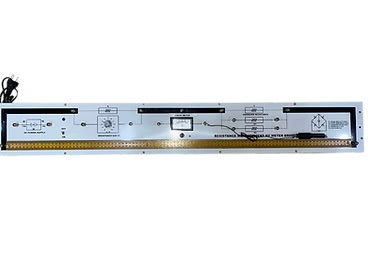
Order the acclaimed Meter Bridge-crafted for reduced maintenance and lofty accuracy in electrical resistance measurement. This classic instrument features a lavish 1-meter calibrated scale, marked in millimeters and centimeters for easy readings. Its spring-loaded jockey offers smooth sliding contact, while the wooden base is insulated for minimized leakage. Heavy brass terminals provide secure circuit connections, and the polished, anti-corrosive finish promises durability. Lightweight and portable, it is tailored for school and college laboratories, making it a preferred choice among manufacturers and suppliers across India.
Meter Bridge: Versatility and Usage
The Meter Bridge is a physics laboratory instrument primarily used for measuring unknown electrical resistance. It is widely employed by students, educators, and laboratory technicians in schools and colleges. Its classic, manual operation and reliable scale make it suitable for both demonstration and experimental analysis. With its standard length and durable construction, the Meter Bridge supports repeated classroom usage, helping learners grasp fundamental principles of electricity with clarity and hands-on experience.
Stock Ready Packaging and Export Markets
Our Meter Bridges are kept in stock ready for rapid dispatch, ensuring prompt exchange and swift arrival. Each instrument is expertly packaged to minimize transit damage and maintain pristine quality upon delivery. The main domestic market is India, with strong exports to educational suppliers in Asia, Africa, and the Middle East. With favorable exchange and flexible order quantities, we guarantee efficient service and reliable supply for both individual and bulk requirements globally.
FAQ's of Meter Bridge:
Q: How does a Meter Bridge work in laboratory experiments?
A: A Meter Bridge operates on the Wheatstone Bridge principle to measure unknown electrical resistance. By adjusting the jockey contact along the scale, users can balance the bridge and determine resistance values from the calibrated divisions.
Q: What materials are used in the construction of the Meter Bridge?
A: The Meter Bridge is primarily made from seasoned wood, heavy brass, Bakelite terminals, and a uniform resistance wire (usually Constantan or Manganin). These materials contribute to its durability and accuracy.
Q: When should the contacts and terminals be cleaned?
A: Periodic cleaning of the brass terminals and spring-loaded jockey contact is advised to ensure low resistance and reliable connections, especially before conducting any new experiment or demonstration.
Q: Where is the Meter Bridge most commonly used?
A: It is most commonly found in educational settings such as school and college physics laboratories for practical experiments involving electrical measurements.
Q: What are the benefits of using a Meter Bridge with a polished, anti-corrosive finish?
A: The polished, anti-corrosive finish ensures the Meter Bridge remains in excellent condition over time, reducing maintenance requirements and preserving measurement accuracy during repeated laboratory use.
 Send Inquiry




 Send Inquiry

 Send Inquiry